Overclimb Protection for Cat Nets: Why Some Cats Climb Over and How to Stop Them
By BOY Cat Nets Editorial Team ·
A cat net secures the balcony but some cats climb it straight to the top and swing themselves over the edge. Overclimb protection solves this problem with a single targeted accessory. This article explains which cats need it, how it works, and what distinguishes the BOY stainless steel solution from alternative approaches.
The Most Important Points at a Glance
- Overclimb protection is necessary for cats that have learned to climb the net to the top edge and pull themselves over - a behaviour that occurs more often than most owners expect.
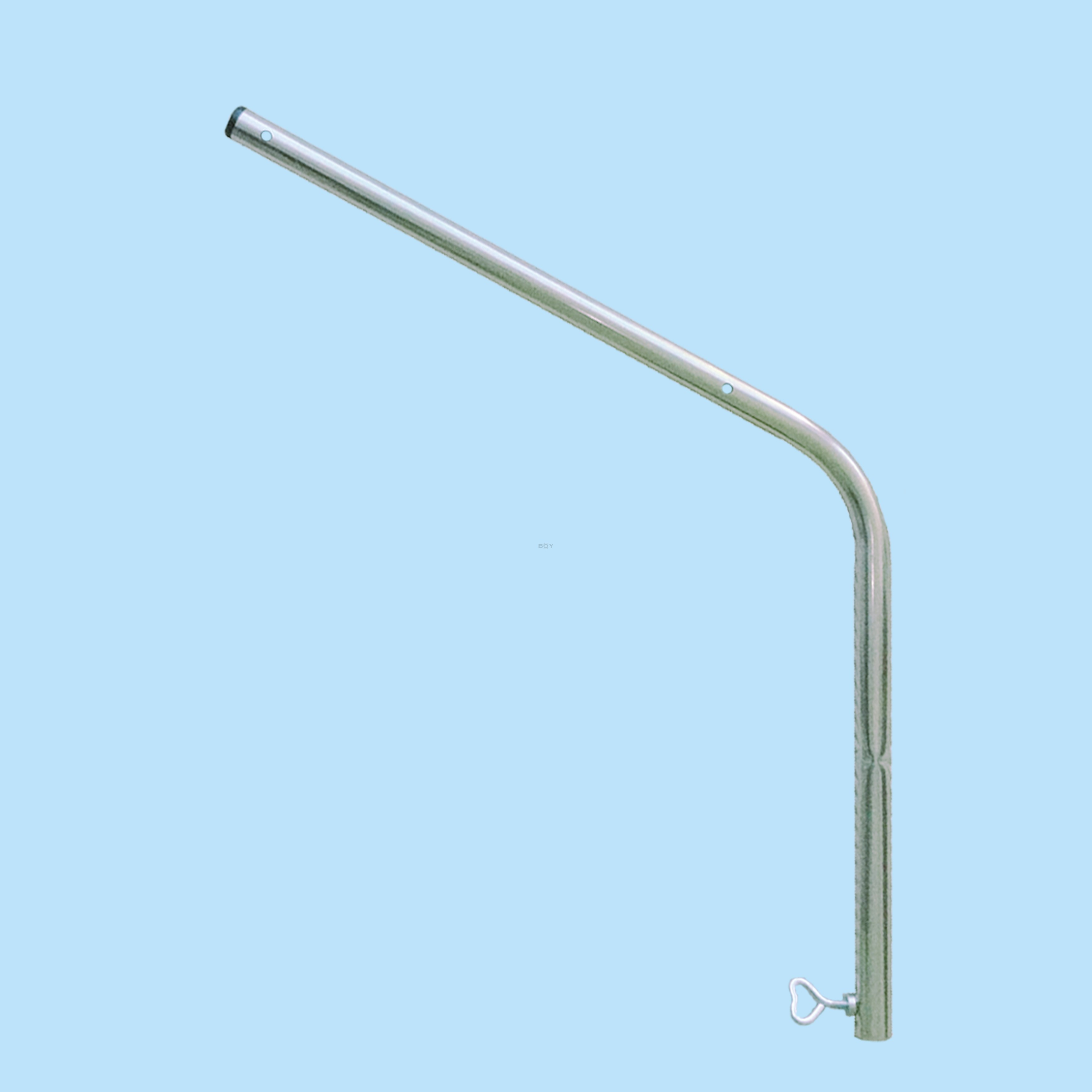
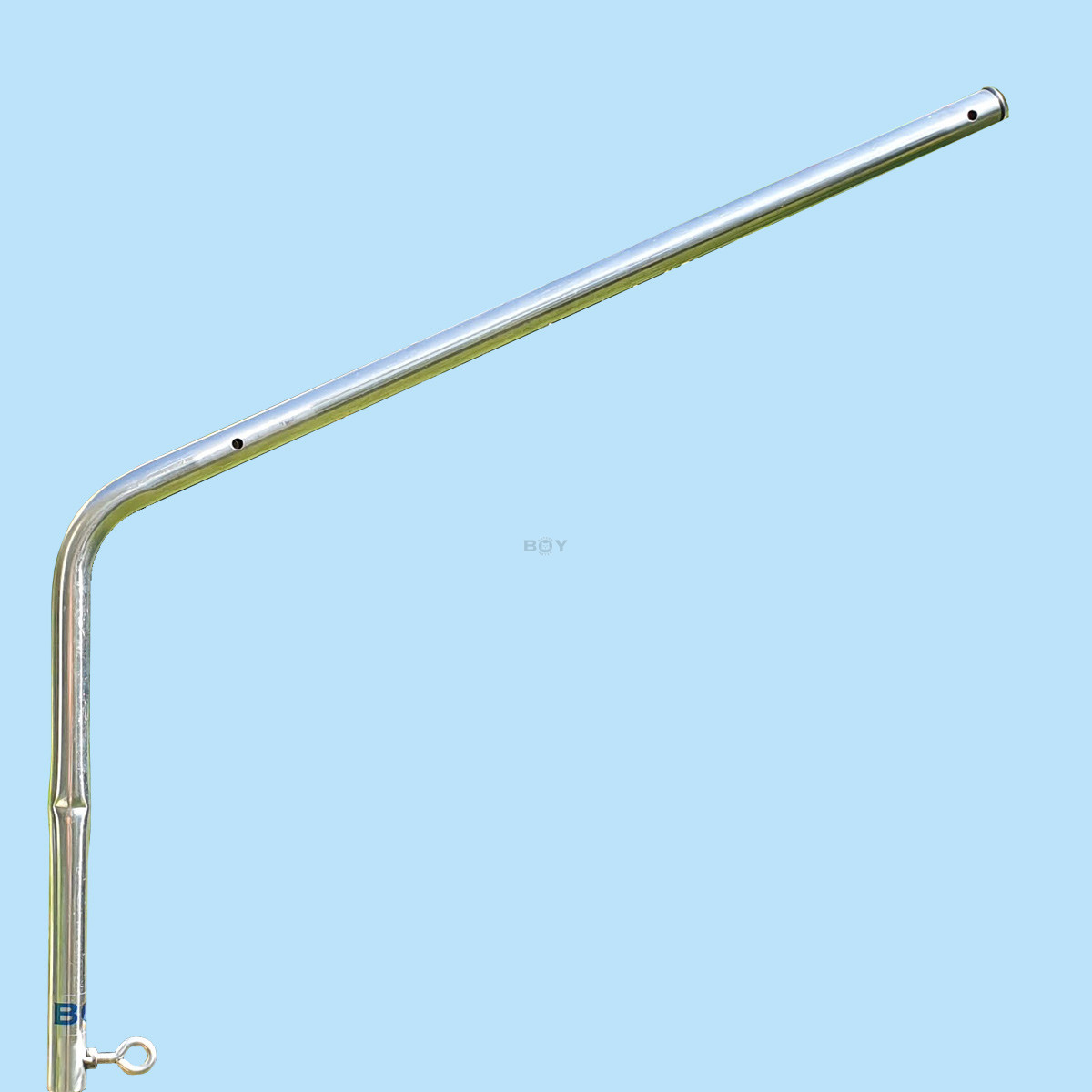
- The BOY stainless steel overclimb guard attaches directly to the telescopic pole and is angled at approximately 115° inward - deliberately designed to minimise the horizontal surface a cat can use as a grip during a climbing attempt.
- Stainless steel requires no paint or protective coating and remains dimensionally stable after years of outdoor use in rain and UV exposure.
- Overclimb protection does not replace the cat net, it works together with it. The net must still be correctly sized, tensioned, and mounted.

A properly installed cat net stops the vast majority of cats without any additional measures. But a subset of cats, typically those that are highly active, have strong territorial or hunting instincts, or have simply discovered through trial and error that the net can be climbed will reach the top edge and attempt to pull themselves over. For these cats, the net alone is not enough. Overclimb protection addresses exactly this scenario.
Which Cats Need Overclimb Protection?
Not every cat will attempt to climb over a correctly installed net. The behaviour is most common in cats with one or more of the following characteristics:
- High activity level - cats that climb everything in the home: shelves, door frames, curtains
- Strong outdoor motivation - cats that have had previous outdoor access and are now kept indoors
- Young cats and adolescents - particularly between 6 months and 2 years, before territorial behaviour settles
- Certain breeds - Bengal, Abyssinian, Maine Coon, Savannah, and other highly active or large breeds are more likely to test the net's upper edge
- Cats that have escaped before - once a cat has successfully climbed over a net or barrier, it will attempt the same route again
The tell-tale sign is straightforward: if you observe your cat climbing the net upward rather than just patting at it horizontally, and particularly if it reaches the top edge and tests whether it can hook its paws over, overclimb protection is the appropriate response. Waiting until the first successful escape which typically happens quickly once the cat has identified the route - means the problem has already occurred.
How the BOY Overclimb Guard Works

The BOY overclimb guard is a stainless steel bracket that mounts onto the telescopic pole at the top edge of the net. The angle approximately 115° inward is the key design decision. At 90° (straight horizontal), a cat would have a flat ledge to grip and could potentially hook its body over. At 115° the bracket tilts inward and downward, which means the cat's paws find no stable horizontal surface to grip during the critical moment of the climbing attempt. The cat reaches the bracket, finds no usable grip, and retreats.
The bracket itself is made from stainless steel, the same material used for BOY's premium telescopic poles. Stainless steel does not rust, does not require repainting, and does not deform under the mechanical load of a cat repeatedly testing it. Powder-coated steel alternatives develop small surface cracks over time through which moisture enters, and the coating eventually chips in outdoor conditions. Stainless steel eliminates this maintenance requirement entirely.
Installation is straightforward: the guard clips onto the telescopic pole at the top, at the point where the pole meets the upper edge of the net. No additional tools are required beyond what is used for the pole installation itself. Each guard covers one pole position, for a standard balcony with three or four poles, three or four guards are needed.
The 115° Angle - Why It Matters
The angle of overclimb protection is not an arbitrary specification, it directly determines how effective the protection is. Consider three scenarios:
← Scroll table to the right →
| Angle | What the cat encounters | Effectiveness |
|---|---|---|
| 90° (horizontal) | A flat ledge - the cat can hook its front paws over and lever itself up | Low - provides a grip surface |
| 105-110° | A slight inward tilt - reduces grip but a determined cat may still manage | Moderate |
| 115° (BOY) | A pronounced inward-downward angle - the cat's paws slide off the bracket surface during the leverage attempt | High - no usable grip surface |
| 125° (alternative) | A steeper angle - also effective, but the larger bracket protrudes further into the balcony space | High - but larger physical footprint |
BOY has chosen 115° as the point that maximises effectiveness while minimising the bracket's protrusion into the balcony area. A bracket at 125° works well but extends further inward, a consideration for narrow balconies where every centimetre of usable space matters.
Overclimb Protection and Net Choice: What Works Together
Overclimb protection addresses the top edge of the installation but it only works correctly when the net itself is also properly installed. A loose net with significant sag near the top gives the cat an easier climb, because the sagging section reduces the effective height of the barrier before the bracket is reached. The net should be tensioned so it hangs with only moderate sag, enough to be flexible and difficult to grip, but not so loose that it creates a large horizontal surface for the cat to stand on at height.
The BOY overclimb guard is compatible with all six BOY net variants: Standard, Transparent, Robust, Extra Strong, Wire-Reinforced, and Extrem and with all BOY telescopic pole models, both galvanised steel and stainless steel. For cats that both chew aggressively and attempt to climb over, the combination of Wire-Reinforced or Extrem net with overclimb protection covers both risk vectors simultaneously.
Pole spacing also matters: poles should be no more than 2 m apart. Wider spacing allows the net to sag more between poles, which can provide the cat with intermediate grip points on the way up. Correct pole spacing reduces this and makes the overclimb guard's job easier.
Stainless Steel vs. Powder-Coated Flat Steel
Two materials are used in overclimb protection products currently available on the German market: stainless steel and powder-coated flat steel (warmgewalzter Flachstahl mit Pulverbeschichtung). The functional difference becomes relevant primarily over time and in permanent outdoor conditions.
Powder-coated steel is less expensive to produce and works well initially. The powder coating provides corrosion resistance, but outdoor exposure to UV radiation, temperature cycles, rain causes micro-cracks in the coating over months and years. Once moisture reaches the underlying steel, surface rust develops. This does not cause immediate structural failure, but it does mean the product eventually needs replacing and may leave rust marks on balcony surfaces. Stainless steel has no coating to crack and no underlying steel to rust. Its appearance and structural integrity remain unchanged after years of outdoor installation.
For a product that is mounted permanently on an outdoor balcony, garten or terrasse and expected to function without maintenance for the life of the cat net, stainless steel is the appropriate material. BOY's overclimb guard uses stainless steel for this reason the same rationale behind the stainless steel telescopic pole option for permanent outdoor use.
Installing Overclimb Protection: What to Plan For
Installing overclimb protection requires no specialist tools and no drilling. The steps integrate directly into the standard BOY telescopic pole installation:
- Install the telescopic poles as normal - attached to the balcony railing or clamped floor-to-ceiling (tension poles), spaced approximately 2 m apart.
- Mount the overclimb guard onto each pole at the top, at the level of the net's upper edge. The guard clips onto the pole head and locks in position.
- Hang the net as normal - thread the braided cord through the top row of meshes and attach to each pole. The guard sits above the net's top edge.
- Check the angle from the cat's perspective: stand at balcony level and confirm the guard faces inward and downward, with no horizontal ledge visible from below.
BOY's overclimb guard is available from €16.95 per piece. For a standard balcony with three poles, three guards are required - one per pole. Step-by-step installation videos for the full pole and net system are available on the BOY website. Phone consultation is available before and after purchase for any installation questions.
Does Overclimb Protection Work for Every Cat?
Overclimb protection significantly raises the barrier for cats that attempt to climb over but it is not a guarantee for every individual animal under every condition. The 115° angle removes the grip surface that most cats need for the critical leverage moment at the top of the net. However, a very large cat with exceptional reach, or a cat that has found a way to approach the bracket from an unusual angle (for example, by jumping onto a nearby piece of furniture that is level with the top of the net), may require additional measures.
The most important complementary measure is removing any furniture, plant pots, or structures near the balcony railing that give the cat a platform at or above net height. A cat that can jump directly to the level of the bracket from a nearby surface bypasses the climbing phase entirely. Overclimb protection works in combination with correct net installation and a balcony environment that does not offer alternative routes to the top edge.
If you are unsure whether overclimb protection is sufficient for your specific cat's behaviour, BOY's phone consultation team can advise based on your cat's size, breed, and observed behaviour. Over 50 years of installations means the team has encountered essentially every scenario including the most determined escape artists.